The verdict
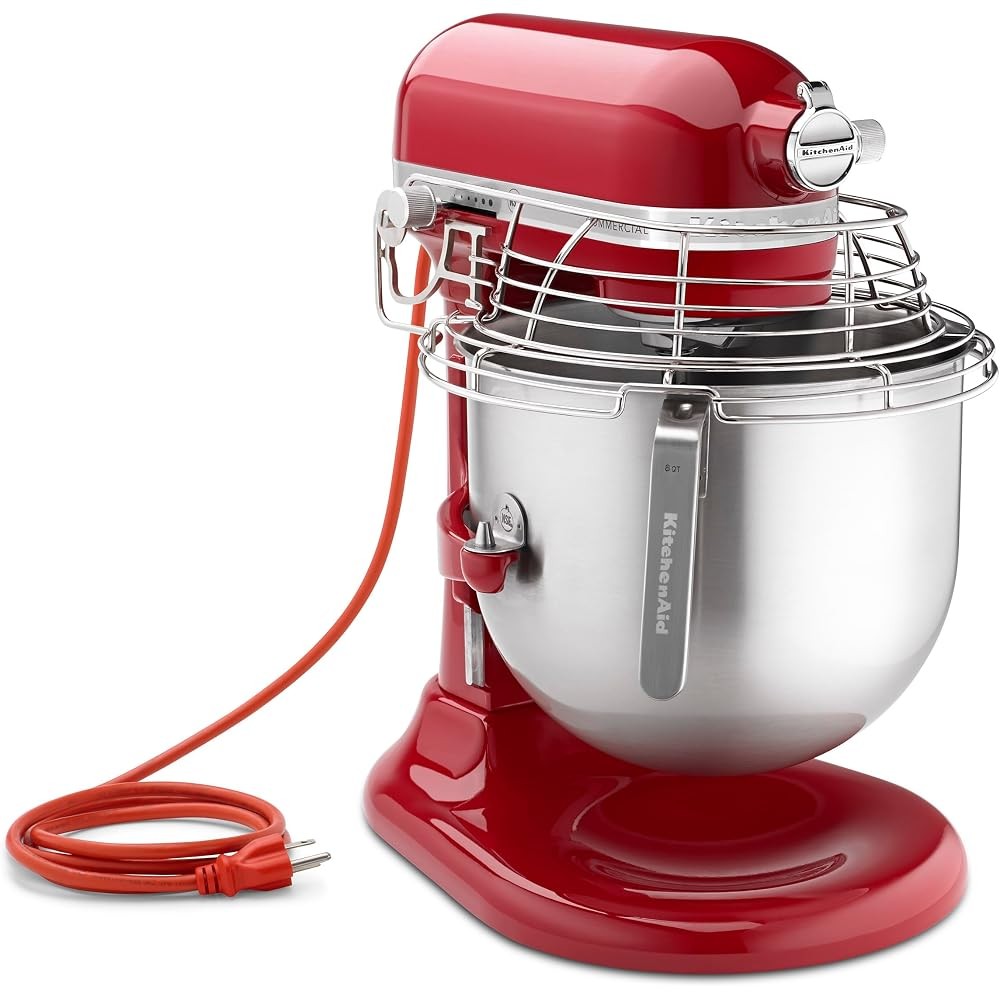
For most kitchens, the KitchenAid Artisan Series 5 is the answer: it is not the most powerful mixer here, but it pairs proven performance with the deepest attachment ecosystem, the widest color range, and service and parts in every corner of the US. Serious bread bakers should step up to our Top Pick, the Ankarsrum Assistent Original — nothing else kneads 11 pounds of dough as gently or carries a 7-year warranty. The value pick is the Bosch Universal Plus at $399: it out-kneads mixers costing twice as much, and the Hamilton Beach Eclectrics at $249.99 is the cheapest all-metal way into the category.
Questions, answered
Tilt-head or bowl-lift: which should I buy?
Tilt-head models (the Artisan Series 5, Classic, Mini, Cuisinart, Smeg) are easier to load and scrape, and the head swings up for beater changes. Bowl-lift models (the KitchenAid 7 Quart and Commercial KSMC895) fix the head to a rigid frame, so they stay steadier under stiff, heavy doughs and suit bakers who run big batches often. If you mostly bake cakes, cookies, and occasional loaves, tilt-head is simpler. If bread is a weekly habit, bowl-lift — or the Ankarsrum's rotating-bowl design — earns its keep.
How much bowl capacity do I actually need?
A 4.5–5 quart bowl handles a standard batch of cookies (about 8–9 dozen), a two-layer cake, or roughly 1–1.5 pounds of bread flour comfortably. Step up to 6.5–7 quarts if you double recipes, bake for a crowd, or work with stiff doughs regularly — the Bosch (6.5 qt), KitchenAid 7 Quart, and Ankarsrum (7.4 qt) live in that class. Remember that flour capacity, not bowl volume, is the real ceiling: the Smeg's 5-quart bowl tops out near 2.6 pounds of flour, while the Ankarsrum takes 11 pounds of finished dough.
Does a higher wattage mean a more powerful mixer?
No — wattage figures are not comparable across designs. KitchenAid's 325W Artisan rating, Bosch's 500W belt-driven motor, and the Ankarsrum's 600W continuous rating describe different drivetrains: planetary heads, a bottom-drive belt, and a rotating bowl. Torque, gearing, and how the beater meets the bowl matter more than the number on the box. The Bosch and Ankarsrum knead heavier dough than several higher-wattage tilt-heads precisely because their designs put the work into the bowl instead of the head.
What warranty should I expect on a stand mixer?
One year is the industry default (KitchenAid's home line, Smeg). Better coverage exists if you look: Cuisinart and Hamilton Beach offer 3 years, the KitchenAid Commercial KSMC895 carries 2 years, the Bosch Universal Plus covers its motor and transmission for 3 years through NutriMill, and the Ankarsrum leads the field at 7 years on the machine base. Because a mixer is a long-life appliance, warranty length and US parts availability carry real weight in our scoring.
Are the manufacturer colors the same as the colors on Amazon?
Not always. Amazon often splits a model's colors across separate listings, and some finishes sold there are discontinued or third-party stock. The color swatches on each card in this ranking come from the manufacturer's own current listing for that exact model — for example, the KitchenAid Classic comes only in White and Onyx Black, while the Artisan Series 5 is offered in more than 20 finishes. If a color matters to you, buy it through the manufacturer's page or an authorized retailer so the warranty registration matches.
Prices are typical US street prices observed during
research and change often — check the retailer for the current price.
ARI may earn a commission from links on this page; commissions never
change a score. See the affiliate
disclosure and methodology.