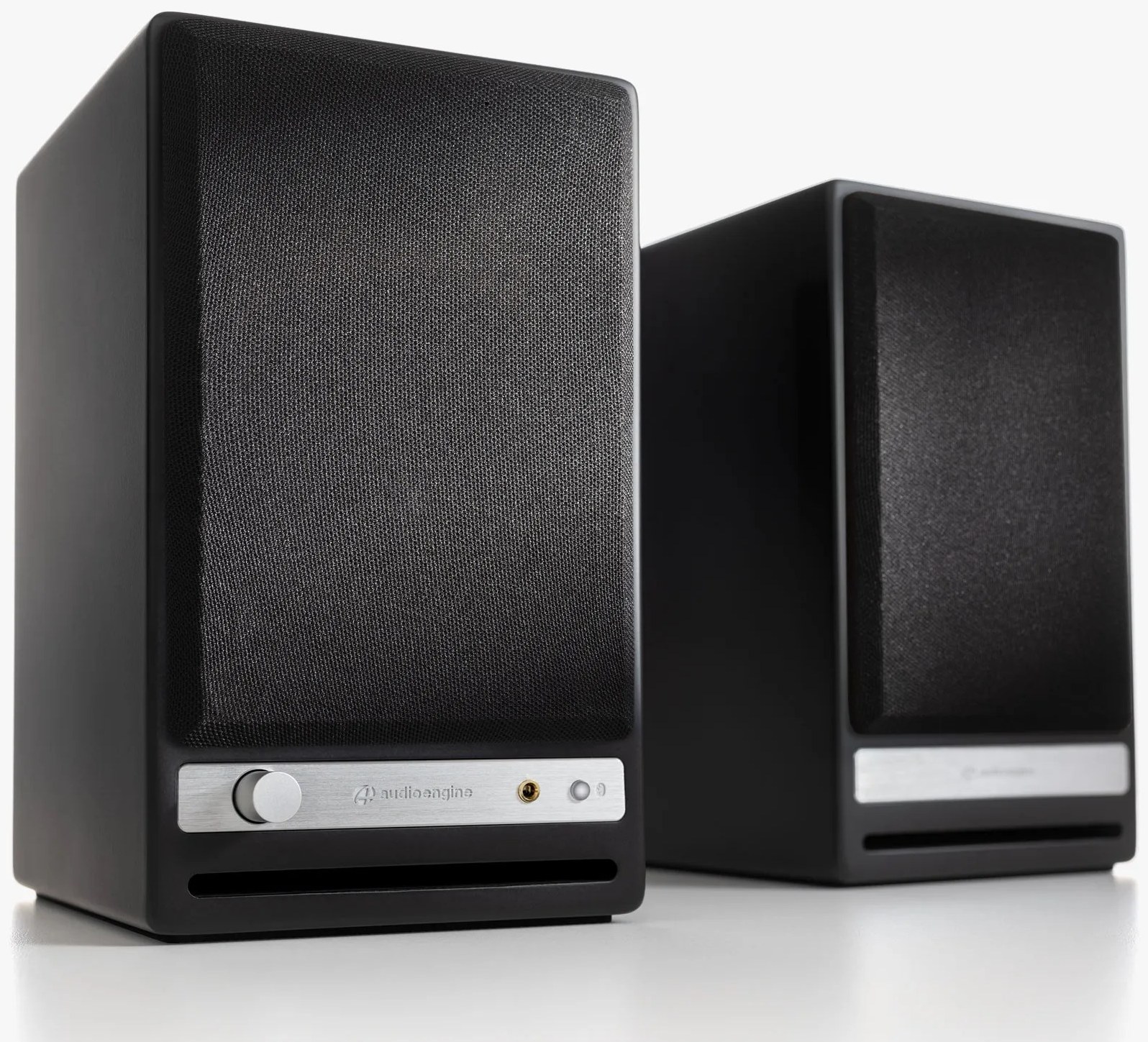
The verdict
Buy the Audioengine HD4 Next Gen if the budget allows: its Class AB amplifier, 4-inch aramid woofers and built-in headphone amp make it the most complete desk system here, backed by a 3-year warranty and US phone support. The A2+ Gen 3 is the better fit for a small desk, and the Fluance Ai41 delivers the most output per dollar. Under $200, Edifier's R1700BT and R1280DBs are the honest buys, and the Creative Pebble V3 is the floor of the category — $44.99, one USB-C cable, and enough clarity for calls and casual listening.
Questions, answered
Powered or passive speakers — which belong on a desk?
Powered. The amplifier is built into one cabinet, so the pair connects straight to a computer, phone or TV with no receiver or speaker amp in between. Every product in this ranking is powered (also called active); passive bookshelf speakers need a separate amplifier and are a different purchase.
Which connection is best for a computer: USB-C, Bluetooth or optical?
USB-C where it is offered (A2+ Gen 3, HD4 Next Gen, Nommo V2 X, Pebble V3): it carries digital audio past the computer's own analog output and usually sounds cleaner. Optical suits TVs and game consoles. Bluetooth is the convenience option for phones. A 3.5mm or RCA cable always works, but it leans on the source's built-in DAC.
Do I need a subwoofer output?
Only if you may add a subwoofer later. Small drivers roll off between roughly 55 Hz and 100 Hz, so music with real bass benefits from a sub. Six of the ten pairs here include a sub-out (HD4 Next Gen, A2+ Gen 3, Ai41, YU4, R1850DB, R1280DBs); the R1280DBs and Ai41 engage a proper crossover when a sub is connected.
How much power do desktop speakers actually need?
Less than the marketing suggests. At a desk you sit about a meter away, so 40–70W RMS total is ample for clean, loud nearfield listening. Driver size, cabinet volume and tuning matter more than peak-watt figures, which is why the 66W R1700BT outplays several nominally '140W peak' rivals.
Are studio monitors good as computer speakers?
Yes, for accuracy — the KRK Rokit 5 G5 is the flattest, most tunable sound in this ranking. The trade-offs are practical: monitors use balanced XLR or 1/4-inch inputs, so a computer needs an audio interface or adapter cable, and there is no Bluetooth, no USB audio and usually no remote.
Prices shown are for the complete set as sold for one desk — a pair where the maker sells them as a pair. Prices are typical US street prices observed during research and change often — check the retailer for the current price. ARI may earn a commission from links on this page; commissions never change a score. See the affiliate disclosure and methodology.